UX Design + Research · WEX · Innovation Group · 6-Month Contract

When the Product Gets Killed — and What

Comes Next

When the Product Gets Killed — and What Comes Next

A 6-month contract with WEX's innovation group that began as an Earned Wage

Access product design for truck drivers — and evolved into something more

strategically valuable after the product was cancelled.

Strategic Research

0→1 Product Design

AI-Assisted Discovery

Fintech

Fleet & Fuel

Innovation
The Context

A new product, a new industry, and a hard deadline.

WEX is a global payments company specializing in fleet fuel cards and financial solutions for

commercial trucking and transportation. Their innovation group was exploring an Earned Wage Access

(EWA) feature — a way for truck drivers to access their pay before payday — to be built into an existing

driver-facing app called PayControl.

WEX is a global payments company specializing in fleet fuel cards and financial solutions for commercial trucking and transportation. Their innovation group was exploring an Earned Wage Access (EWA) feature — a way for truck drivers to access their pay before payday — to be built into an existing driver-facing app called PayControl.

I was brought in on a 6-month contract as the UX design and research lead. I knew nothing about commercial trucking or fuel cards. The timeline was tight, the product was starting from zero, and the domain expertise I needed didn't exist in my background — so I had to build it fast.

I was brought in on a 6-month contract as the UX design and research lead. I knew nothing about

commercial trucking or fuel cards. The timeline was tight, the product was starting from zero, and the

domain expertise I needed didn't exist in my background — so I had to build it fast.

My Role

My contributions

What I led and owned

Used AI during discovery to rapidly build domain expertise in commercial trucking — separating

company drivers from owner-operators and building persona profiles grounded in their real

financial lives

Used AI during discovery to rapidly build domain expertise in commercial trucking — separating company drivers from owner-operators and building persona profiles grounded in their real

financial lives

Partnered with the lead product manager to interview internal stakeholders on organizational

capability and readiness to support the product post-launch

Partnered with the lead product manager to interview internal stakeholders on organizational capability and readiness to support the product post-launch

Collaborated with engineering to map the available tech stack and identify integration constraints

Worked with the Over the Road line of business to evaluate PayControl as the right host app for the EWA feature

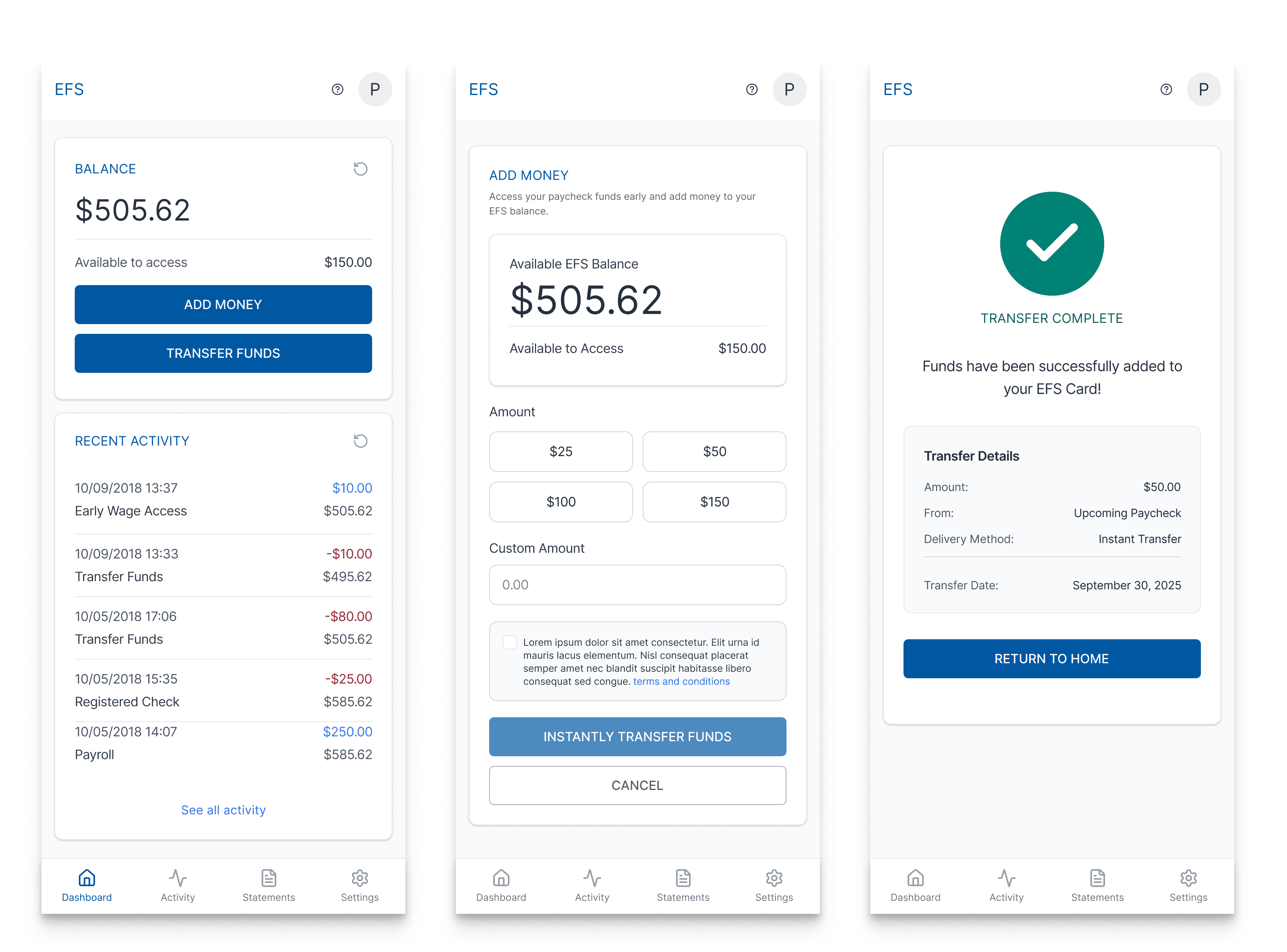
Designed flows and screens showing how Earned Wage Access would integrate into PayControl

Identified and clearly documented the barriers that ultimately led to the product being cancelled

Proposed and created an organization-wide ecosystem map after the project was nixed — mapping lines of business, tech stacks, and data assets to help the innovation group move faster on future ideas

How the Project Evolved

Three acts in six months

Act 01 — Discovery

Learning a new industry from scratch — with AI as a research accelerator

With no background in trucking or fleet payments, I used AI during the discovery phase to quickly build

foundational knowledge — first understanding the general weekly journey of a truck driver, then getting specific

about the difference between company drivers and owner-operators. From there I built persona profiles and dug

into why drivers might want early pay beyond the obvious emergency scenario: cash flow gaps between loads, fuel costs coming due before pay arrives, the financial volatility of life on the road. This gave me enough grounding to ask better questions of real stakeholders.

With no background in trucking or fleet payments, I used AI during the discovery phase to quickly build foundational knowledge — first understanding the general weekly journey of a truck driver, then getting specific about the difference between company drivers and owner-operators. From there I built persona profiles and dug into why drivers might want early pay beyond the obvious emergency scenario: cash flow gaps between loads, fuel costs coming due before pay arrives, the financial volatility of life on the road. This gave me enough grounding to ask better questions of real stakeholders.

Act 02 — Design + Validation

Designing the EWA feature and uncovering why it couldn't be built

Working alongside the product manager, I interviewed internal stakeholders to assess organizational capability and

the available tech stack with engineering. I also worked with the Over the Road line of business to evaluate PayControl — the existing driver-facing app — as the right product to house the feature. I designed flows

and screens showing how EWA would integrate into PayControl. But the research kept surfacing barriers that

couldn't be designed around.

Working alongside the product manager, I interviewed internal stakeholders to assess organizational capability and the available tech stack with engineering. I also worked with the Over the Road line of business to evaluate PayControl — the existing driver-facing app — as the right product to house the feature. I designed flows and screens showing how EWA would integrate into PayControl. But the research kept surfacing barriers that couldn't be designed around.

Act 03 — Pivot

The product was cancelled. The question became: how do we fail faster next time?

After the EWA project was nixed, the director of the innovation group asked a question that reframed the entire

contract: "How might we have been able to fail quicker?" My answer was an organizational ecosystem map — and it

became the most impactful thing I delivered.

After the EWA project was nixed, the director of the innovation group asked a question that reframed the entire contract: "How might we have been able to fail quicker?" My answer was an organizational ecosystem map — and it

became the most impactful thing I delivered.

Why the Product Was Cancelled

The barriers research uncovered

Surfacing these constraints clearly and early was itself a valuable outcome — it gave the innovation

group the evidence they needed to make a clean call rather than continuing to invest in something that

couldn't be sustained.

Surfacing these constraints clearly and early was itself a valuable outcome — it gave the innovation group the evidence they needed to make a clean call rather than continuing to invest in something that couldn't be sustained.

Tech stack maintenance gap

No internal team had the capability or capacity to own

the tech once the product was built — a blocker that

stakeholder interviews made clear early on

No internal team had the capability or capacity to own the tech once the product was built — a blocker that stakeholder interviews made clear early on

Wrong host app

PayControl — the app chosen to house the EWA feature

— was already being considered for deprecation by its

product managers, making it a risky foundation for a new

feature

PayControl — the app chosen to house the EWA feature — was already being considered for deprecation by its product managers, making it a risky foundation for a new feature

Roadmap misalignment

The EWA feature didn't align with the existing plans of the

teams whose infrastructure it depended on — creating

organizational friction that couldn't be resolved within

the contract timeline

The EWA feature didn't align with the existing plans of the teams whose infrastructure it depended on — creating organizational friction that couldn't be resolved within the contract timeline

No clear ownership path

Even if built, there was no obvious team or line of

business positioned to own, iterate, and support the

product long-term
The Pivot

The question that changed the contract

"How might we have been able to fail quicker?"

The innovation group's director asked this after the EWA project was cancelled. My answer: build a

map of the organization so the next idea doesn't run into the same invisible walls.

From cancelled product to organizational asset

My rationale was straightforward: the barriers we hit weren't unknowable — they were just unknown. If

the innovation group had visibility into what tech stacks, data assets, and capabilities existed across

WEX's lines of business before starting a project, they could anticipate blockers, identify the right

partners earlier, and make faster go/no-go decisions.

My rationale was straightforward: the barriers we hit weren't unknowable — they were just unknown. If the innovation group had visibility into what tech stacks, data assets, and capabilities existed across WEX's lines of business before starting a project, they could anticipate blockers, identify the right partners earlier, and make faster go/no-go decisions.

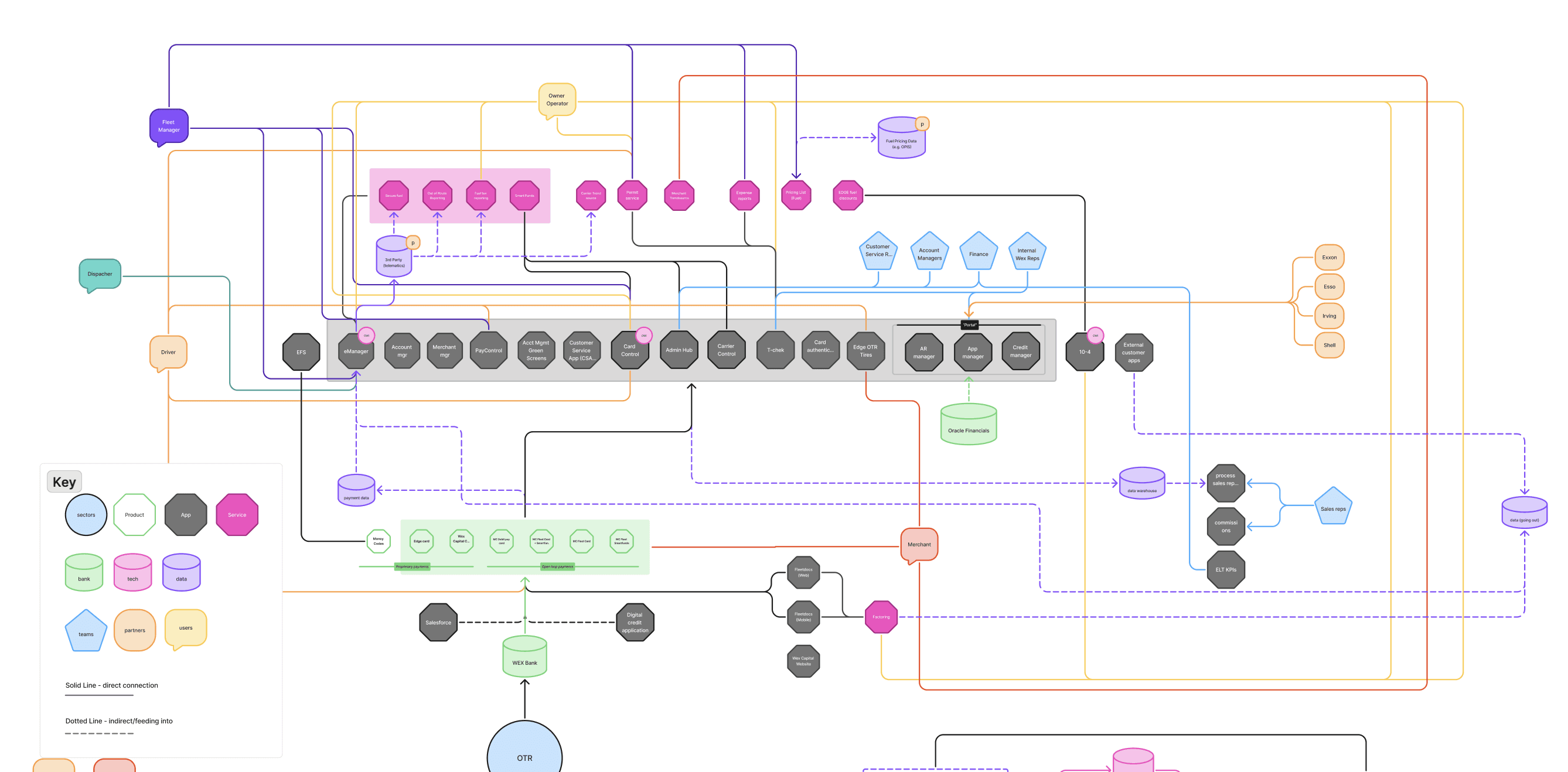
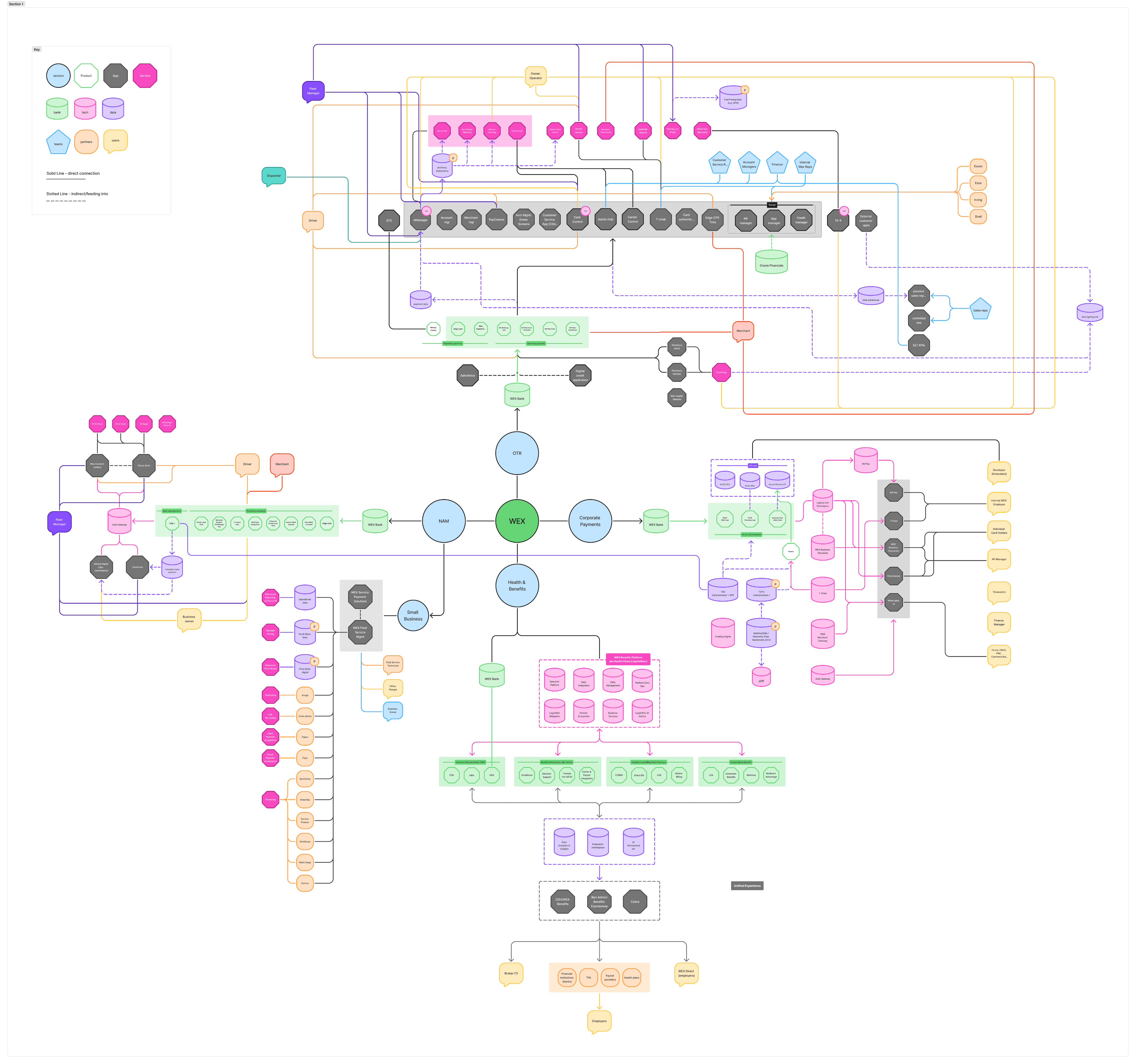
I closed out my contract designing and presenting an organization ecosystem map to product managers across the company — a strategic artifact that had nothing to do with the original brief and everything to do with what the organization actually needed.

I closed out my contract designing and presenting an organization ecosystem map to product

managers across the company — a strategic artifact that had nothing to do with the original brief and

everything to do with what the organization actually needed.

Lines of business

Mapped WEX's internal business

units and their relationships to one

another — surfacing who owned

what

Mapped WEX's internal business units and their relationships to one another — surfacing who owned

what

Tech & data assets

Documented existing tech stacks

and data across the org — making

invisible infrastructure visible for

future planning

Documented existing tech stacks and data across the org — making invisible infrastructure visible for

future planning

Strategic connective tissue

Gave the innovation group a

reference for identifying the right

stakeholders and anticipating

integration barriers before a

project begins

Gave the innovation group a reference for identifying the right stakeholders and anticipating integration barriers before a project begins

Outcome

What the contract produced

The EWA product was cancelled — but the contract delivered two things of lasting value: a clear,

documented record of why a promising idea couldn't move forward, and a strategic tool to help the

innovation group avoid the same fate next time.

The EWA product was cancelled — but the contract delivered two things of lasting value: a clear, documented record of why a promising idea couldn't move forward, and a strategic tool to help the innovation group avoid the same fate next time.

Informed cancellation

Research-backed documentation

of barriers gave leadership the

evidence to make a fast, clean

decision rather than continuing to

invest in a dead end

Research-backed documentation of barriers gave leadership the evidence to make a fast, clean

decision rather than continuing to invest in a dead end

Ecosystem map delivered

A first-of-its-kind organizational

reference shared with PMs across

WEX — built to help the innovation

group move faster on future ideas

A first-of-its-kind organizational reference shared with PMs across WEX — built to help the innovation

group move faster on future ideas

A model for failing faster

The map gave the innovation group

a repeatable framework for pre-

validating ideas against existing

organizational constraints before

investing in design or build

The map gave the innovation group a repeatable framework for pre-validating ideas against existing

organizational constraints before investing in design or build

Methods + Tools

AI-assisted domain research

Stakeholder interviews

Persona development

Tech stack mapping

User flow design

Ecosystem mapping

Strategic synthesis

Cross-org facilitation

Figma